
Blasi's shock win: a late bloomer's audacious climb to spanish cycling glory
Paula Blasi didn’t expect to be in the Amstel Gold Race. And the race certainly didn’t anticipate her arrival. It began with a spontaneous wait, a meticulously planned gamble, and a single sentence that completely altered the course of her career – ‘Wait a couple of days if anyone feels unwell.’ She stayed. And, almost unknowingly, a victory was forged, now a cornerstone of Spanish cycling history.
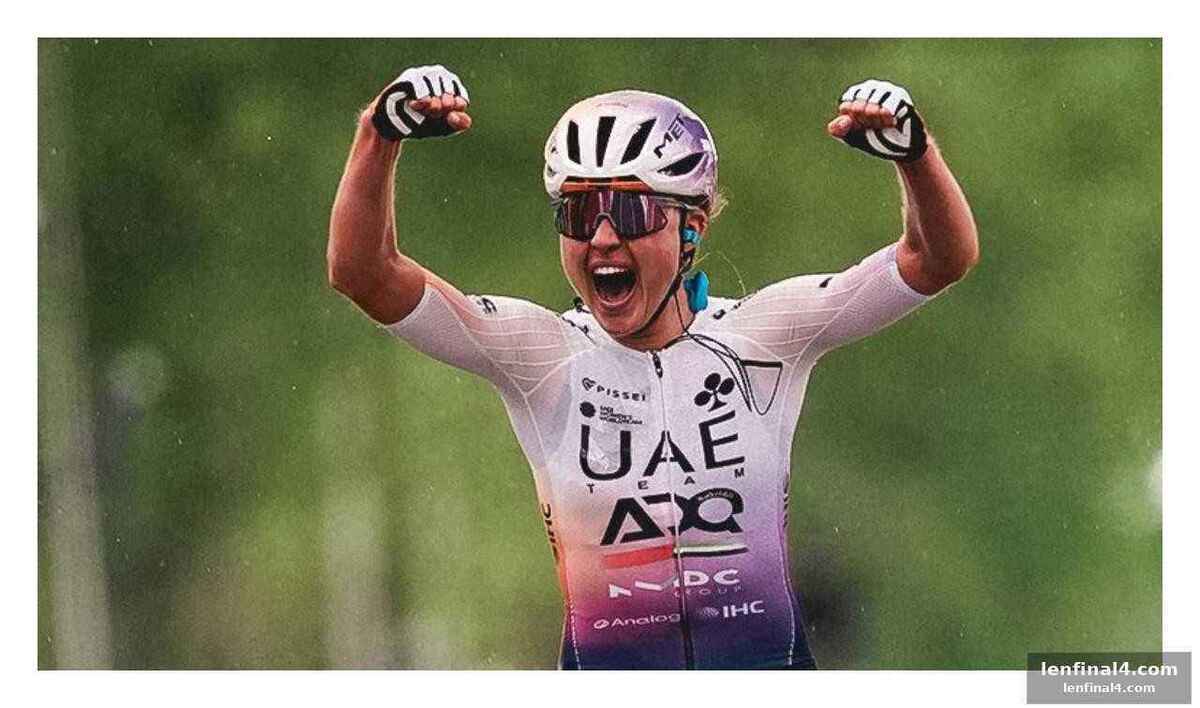
From uncertainty to triumph: a story of instinct and grit
“I thought, ‘Well, okay, I’ll wait’,” Blasi recounted to MARCA after her stunning display. The domino effect followed swiftly. “Ultimately, two teammates went down, and it was my turn.” From there, she entered treacherous terrain – one of the most notoriously demanding classics on the calendar – with minimal reconnaissance, little recognition of the route, and a disconcerting sense of stepping into the unknown. The Amstel isn't forgiving of newcomers; it’s a brutal battle for position, a constant state of tension, narrow roads, and relentless climbs that erode both strength and confidence. Blasi knew this before the race even started.
“You have to know the circuit, you have to know the course… and I hadn’t even done a reconnaissance,” she admitted. Her approach was almost intuitive. “I said, ‘I’ll just go with the flow and see what happens.’ What happened was the worst-case scenario. ‘If you’re not well positioned, you pay a heavy price,’ she explained. And she did. She was dropped, lost the rhythm of the race, and watched her chance at a major result slip away prematurely. ‘There was a point where I was left behind in a second group, and I thought my race was over’.
However, that’s where her character truly emerged. Blasi isn’t a typical cyclist. She arrived late to the sport, having previously competed in biathlon, but with an uncommon voracity. In just two years, she’s transformed from an unknown rider into a force to be reckoned with at the elite level. It’s not a fluke. She possesses drive, but also a fiercely competitive personality. Alex Carera, her manager at A&J All Sports – the same agency that represents Pogacar – succinctly captures her essence: ‘She’s a girl with immense determination, so much so that she won the first race she entered.’ This observation underscores her status as a genuine breakthrough, not a fleeting phenomenon. Carera sees in her a rare combination of ambition and raw talent. ‘She’s joining forces with talent and will undoubtedly make a name for herself,’ he remarked.
“She has a contract with UAE for next year. She’ll race in LaVuelta.” He adds, “She’ll be a complete cyclist. As Marco Belotti tells her, there’s considerable potential there.” Blasi herself displayed her characteristic determination during the race’s most critical moment. “I told the girls, ‘I’m sorry, today isn’t my day. I’m not positioning myself correctly. Ask me anything, I’ll keep working until I can’t anymore.’” There’s a momentary resignation, but also generosity and a quiet sense of pride. The race wasn’t meant to be won, but it was about contributing, about remaining useful. And it was precisely then that everything shifted. The task was to cover attacks. One such attack opened the race. ‘A rider went alone, and I said, ‘I’m going to chase her down and close the gap’,” Blasi recounted. She launched almost instinctively. Looking back, she saw no one. The gap wasn’t just a gap; it was an opportunity. ‘And that’s when I started to dream.’
From feeling out of place to finding her position, from being defensive to understanding that she could transform chaos into opportunity. ‘I went from thinking I was out of the race to saying, ‘Ooh, let’s play,’.” She discovered a terrain that suited her strengths: long efforts, high intensity, and sustained power. ‘I feel better riding alone, strong, not in a sprint.’ Looking ahead, Carera, who has closely followed her development and accompanied her to events in Australia and Rwanda, envisions an ambitious future. ‘Her goal is to win races, and she can conquer a Grand Tour.’ He speaks of the magnitude she’s poised to achieve, a rider still refining her technique, yet already competing at the highest level. “She started saying, ‘Ooh, ooh, ooh…’ and she’s going all the way,” she added, recalling the kilometers where disbelief transformed into certainty. The finish wasn’t just a line; it was a symbolic border. No Spanish cyclist had ever won the Amstel, in either men’s or women’s competition. Blasi shattered that barrier with remarkable speed. ‘I’m aware that I don’t even know what this means,’ she confessed. Even this victory doesn’t fundamentally change her demeanor. She now looks ahead with ambition, not anxiety. LaVuelta is already on the horizon, within a team that fully trusts her abilities. But, by now, nobody doubts that she’s here to stay.”